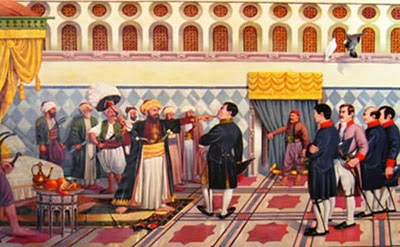
The Fly Whisk Incident
The causes and consequences of the fan accident:
France's debts to the companies "Boukhrais" and "Boushnak" have increased to the point that the company's owners have threatened French Minister Talleyrand and French Consul in Algeria "Duval" with a part of the debts if they succeed in persuading the French government to pay it. Talleyrand did, in fact, interfere in the case, ordering the French government to settle debts.
The Dey realized the conspiracy's thread in Algeria was Consul Duval, and its head in Paris was Talleyrand. The Dey understand that approaching the French Government through its Consul will have no results as long as the Consul is a party to the matter. At the time, the liberal French press accused Consul Deval of stealing two million francs from the payments paid to Boushnak and Bakri. As a result, the Dey did not hesitate to accuse the consul of colluded with the Jews, who deceived the Dey and the Algerian treasury and plundered funds belonging to the Algerian treasury for themselves.
As a result, the Dey requested that the French government withdraw its consul from Algeria and transfer Jews in France to Algeria, as they serve only as intermediaries between the Algerian and French governments.
The greatest Algerian battleships were in the Levant at the time, assisting Constantinople, and the French government sought to take advantage of this chance at her request. In order to carry out its strategy to seize Algeria at this time. So she dispatched her consul Duval, instructing him to seize any chance to anger my parents and incite an event that would justify cutting relations and declaring war on Algeria.
France was eager to incite an incident with Algeria at this time because, in addition to what had already been stated, it was aware that the English were prepared to seize Algeria.
The legendary Fly Whisk incident occurred on the
occasion of Eid al-Adha, which occurs on April 29, 1827, and is one of the
grounds that the French government used to commence its military assault
against Algeria at one o'clock in the afternoon.
Foreign consuls, including Duval, arrived as
usual to congratulate my parents on this special occasion. The Pasha and the
French Consul had a direct communication in Turkish concerning France's answer
to his request. The Consul's reaction was equivocal, and it may have been
offensive to the Pasha.
As the conversation progressed, the Pasha accused the consul of being the reason why the response to the letter he got lately from his government did not reach him directly. He mistook it for a directive from the French Foreign Ministry, and that it was about Algerian indebtedness to France. However, this letter was from the French Navy concerning coral fishing in Algeria's east. Thus the pasha ordered the consul to leave and then struck him with a fan when he refused to. Duval said in his report to his government that he had been beaten three times, and the Pasha claimed that he only assaulted him because he had insulted him.
According to another account, the beating did not occur in the first place, but the threat of a beating happened. thus the consul took advantage of the chance he saw, and alerted his government. As a result, the Pasha called some of the French who were present in Algeria and told them the following: “I never intended to insult France” and affirmed them that the consul's conversation with the Dey was but a personal conversation, and that they can remain in Algeria without any harm, in fact, he would protect them and their interests.
It was obvious, however, that it was an intentional provocation. There was nothing in the Dey's conversation that called for such a response. Upon receiving a report from Capt. Cooley at the head of the French Navy, France demanded that the Dey apologize to him.
Weird Alert
France took advantage of the propeller mishap, and the ambassadors of the European nations determined that if it did not gain acceptance of its demands and conditions from Dey Hussein within twenty-four hours, it would impose a naval siege on Algeria. These terms were a fictitious reparation sought by France from the Dey administration, and the Dey himself had to visit the French steamship “Provence” to apologize to Consul Duval for the insult inflicted on him, and that with the presence of all European consuls. Because the French government knew it would be unlikely of the Dey to accept these conditions, they permitted the commander in charge of the siege to offer the Dey one of two alternatives:
1. - Dey Hussein welcomes the commander of the French navy and Consul Duval at his palace, in the presence of foreign consuls, to apologize for what transpired.
2. - A delegation led by the Minister of the Navy would be dispatched to him to obtain a pardon from Duval.
And should the Dey accept one of the aforementioned solutions, he is asked, on the other hand, to execute the following:
1. Algerian artillery to fire a hundred shots in honor of the French flag.
2. The French flag to be raised above all the Algerian fortresses.
3. The Dey to issue compensation for damages and losses incurred by France in its property and business.
4. To punish Algerian commanders on the acts of piracy committed against French ships.
5. Compensation for the damages inflicted on the French Consulate in Annaba.
6. France also demanded that they obtain important guarantees in the future as Algerian sailors are not allowed to visit and inspect French ships.
7. The French government has the right to arm the fortress of El Kala and all its other institutions.
8. Algeria should give up its right to claim the debts of Bakri and Bouchenak.
9. Finally, Algeria must recognize France’s consular priority over other European countries.
It is apparent that what France presented is impossible to achieve, and the Dey, of course, rejected and declared war on France on June 16, 1827. France placed a siege on Algerian shores, which was simple to do given the absence of most of the Algerian navy in Butan. This absence had a significant impact, as the few surviving ships alone could not break the siege. This was also proved by the failure of an effort by Algerian captanins near Ras Kaksene in early October 1827.
Navy siege on Algeria:
Following the April 27, 1827 Fly Whisk Incident, France said that the Algerian government had inflicted a terrible affront on it. They necessitated France's occupation of Algeria, but there was a disagreement among French cabinet members, and two options developed. The first is to impose a naval siege on Algeria's coast. The second, is to carry out the process of landing soldiers on the coast and seizing Algiers.
Because France, as previously stated, was unable to launch a military attack, it lay siege to the Algerian coast for three years prior to the army's invasion in Sidi Fredj. The siege began on June 16, 1827 and lasted until June 18, 1830.
The war fleet left Toulon on June 1, 1827, under the direction of Officer Coley, and arrived at Algiers on June 11, 1827, conveying a warning to the Dey. The carrier of this message was Count "Datili," the Sardinian consul in Algeria who became leader of French interests after Duval's evacuation. He sent in the warning a request to send one of the Algerian officials (Ouakil al-kharadj) to the French fleet to apologize to the French consul Duval in the name of the Dey.
In the same month the siege was announced, General Lefidro was asked to prepare a project containing historical, geographical, statistical and military information that aim at campaigning against Algeria.
The siege persisted instead of the campaign, with the French seeking to cut off supplies to Algeria behind it. Their beleaguered fleet was made up of 11 ships that were patrolling Algerian ports. They were also intercepting suspected ships and arresting others. However, the blockade did not reveal the piracy operations and hence failed. On October 3, a combat occurred between the Algerian and French fleets. The struggle lasted almost four hours and neither side was able to reach an agreement.
However, the siege cost seven million francs every year, and there was the threat of war with Britain or Spain if the siege escalated into a military campaign. Moreover, the French administration changed during 1827. All of these circumstances prompted France to open the door to dialogue with Algeria and aimed at honorably ending the siege.
In the end, the blockade had a disastrous effect on the economic life of Algerian ports, and hence on the rest of the country. It also caused the Algerian treasury to go bankrupt due to a lack of financial resources and restrictions on international commerce, and it was no longer able to accept military aid from outside.
Communication and an endeavor to resolve the problem:
Despite its difficulties, the Sublime Porte attempted to resolve the Algeria-France conflict. This was accomplished by sending missionaries to Dey Hussein in an attempt to persuade him that good relations with France must be reestablished.
· Abderrahman Affendi's mission:
The mission of Abderrahman Affendi is shrouded in mystery. In addition to not knowing its history, we don't know whether it was for the sake of peace or something else. According to Pfeiffer, Abderrahman Affendi came to Algeria to urge that the Dey Hussein prepare 40,000 soldiers for the Sublime Porte in the European fashion, but the Dey ignored the Sublime Porte's request.
· Hafid Mohamed Rachid Bek’s mission:
After completing his duty in Tunisia, Hafid Mohamed Rachid Bek arrived in Algeria in the early months of 1829. His purpose was to solicit naval aid from the Sublime Porte, but during his week-long stay in Algeria, he requested that the Dey Hussein intercede for peace between Algeria and France. However, Dey Hussein denied his intervention since France's terms for accepting peace were unacceptable to him. Furthermore, France did not reimburse Algeria for its losses as a result of the siege. As a result, Mohamed Rachid Bek's expedition, like the last one, failed, and he returned to Tunisia, from where he traveled to Istanbul.
· Khalil Affendi's Mission:
Khalil Affendi was dispatched to Algeria and given two missions immediately after the Sublime Porte signed the Peace Treaty of Adrianople (Treaty of Edirne). The first aim is to improve relations between Algeria and Austria. Sultan Mahmoud II directed the Dey Hussein not to intervene in the conflict between Austria and Morocco. The second job is concerned with Algerian-French ties. Khalil Affendi's mission failed, as he was unable to convince both parties to retreat. Then he left Algeria in June, 1830.
· Taher Bacha’s mission:
Taher Pasha's mission ended on April 16, 1830, when he boarded the cruiser "Nasim Al-Zafar" and left Istanbul. On May 8, 1830, he arrived in Tunisia, bearing the letter entrusted to him by the French ambassador to the siege leader. Taher Pasha attempted to enter Algeria through Tunisia, but was denied entry and first imprisoned there at the request of Tunisia's bey, Hussein Bey, as well as the French consul in Tunisia.