Hafsid Dynasty
Political Aspect:
In reference to Hintata, one of the Masmoudah tribe's, the Hafsid dynasty belongs to Abu Hafs Omar bin Yahya Al-Huntati. Abou Hafs was one of Mohamed Ben Toumert's 10 companions. In the year 625 AH / 1228 AD, he appointed his sons to offices and emirates in Andalusia and Africa. During the time of the Almohad Caliph Al-Ma'moun, Abu Zakaria Yahya declared his departure from the Almohad state in the year 627 AH / 1229 AD, and declared Tunis as the capital of his kingdom, then traveled to Constantine and was able to rule it. Furthermore, in the year 628 AH / 1230 AD, he was able to subdue Bejaia, from which he traveled to the islands of Banou Mezghna and surrendered to his sultan, after which Abou Zakaria al-Hafsi moved to the area of Chlef and came into his allegiance. In 640 AH / 1244 AD, he proceeded to Tlemcen and besieged it, forcing Zayani Ighmerasen Prince to declare his allegiance to the Hafsid Dynasty.
Hafsid Algeria encompassed the provinces of Algiers and Constantine, as well as a portion of the region of Oran, which itself is divided into four states: The countries of Bouna (Annaba), Constantine, Al-Zab and its base in Biskra, and sometimes Makara, the headquarters of the Hodna. The south line extends beyond the country of Argelan (Ouargla). Workers in these Algerian countries frequently rose against the central authority and pledged loyalty to themselves, which is why we observe different boundaries and their overlapping in the Hafsid Algeria era.
Among the most prominent rulers of Algeria during the Hafsid era was the Banu al-Nu'man of the Hentata Masmodia tribe, who were appointed as governor of Constantine by the Hafsi Sultan Abou Zakaria Yahya in the year 628 AH / 1230 AD. They remained kin until they were persecuted by the Hafsid Sultan al-Mustansir in the years 651-653 AH / 1253-1255 AD. As a result, the governor of Constantine, Ibn Kaldasin, from the Almohad sheikhdom, took up residence in Tunis and represented him in the leadership of the state, Abu Bakr Ibn Musa Ibn Issa, also known as Ibn al-Wazir. Abou Hilal Ayad bin Saeed Al-Huntati was assigned to Bejaia in 659 AH / 1261 AD. The Hafsi Sultan Ibrahim I succeeded over his eldest son, Abdel Aziz Ali, in the year 669 AH / 1270 AD. In the year 684 AH / 1285 AD, Yahya ben Ibrahim took over the authority of Bejaia and claimed the title of elect to revive God's religion, and declared his departure from the Hafsid reign in Tunisia, dividing the Hafsid kingdom into two parts: The eastern portion has Tunisia as its capital, and the western section had Bejaia as its capital, with Constantine Ali bin Youssef bin Al-Amin Al-Hamdani as its monarch. After the death of Abu Asida, the two Hafsid kingdoms were consolidated in the year 709 AH / 1309 AD, and after Abu al-Baqa Khalid seized power, he abdicated in the year 711 AH / 1311 AD, and the eastern and western dynasties were therefore joined. The Hafsid dynasty fell under Marinid power in 748 AH / 1347 AD, as they seized Constantine in 749 AH / 1348 AD. The Marinid dynasty, however, lasted just two and a half years. The Marinid Sultan Abu Annan then invaded Bejaia and Constantine in the year 758 AH / 1357 AD, before entering Tunisia. In the same year, the Hafsid Sultan Abu Ishaq was able to restore power in Tunisia, and in 761 AH / 1360 AD, the Hafsid Sultan Abu Ishaq traveled to Bejaia and wrested it from the dominion of Bani Marin.
The Algerian east was prone to Spanish conquest around the beginning of the 10th century AH / 16 AD, therefore Bejaia and Annaba were captured in the year 916 AH / 1510 AD. Then, in the year 917 AH / 1510 AD, Libya was conquered, followed by Tunisia in the year 942 AH / 1535 AD, there until the Ottomans were able to free Hafsid Algeria in addition to Tunisia and Libya. The last of the Hafsid sultan was Mohamed ibn al-Hasan, during whose reign the Hafsid empire fell to the Ottomans in 981 AH / 1573 AD, after ruling Africa for about 354 years, including 315 years in the Algerian east, and all of them became Ottoman states.
Economic Life:
The Hafsids took an interest in agriculture. Constantine, M’sila, and Tubna were famous for growing wheat. The residents of Skikda traded wheat for textiles with the Southerners, and Jijel was famous for producing barley. This grain was harvested in May with a serrated sickle, where the long wheats were chopped after leaving an amount of hay to feed the cattle and then examined by the hoof of the animals. This procedure was mostly used in Constantine. Tebessa, on the other hand, would employ an animal-carried type-of-machine, outfitted with cutting stones and iron blades known as Jarusha. Tebessa used to store grain in landfills in the Aures area, whereas it was stored in palaces with chambers in the Constantine region.
In terms of industry, the textile sector thrived, as seen by the striped coverings (Hanbali) in Annaba. Mila was well-known for their ability to produce sewn bedspreads. Collo was well-known for its leather industry, which was plentiful until it was transported overseas, and the remainder was provided to shoemakers and saddlers who created footwear for troops and officers. Also used in bookbinding, the leather was usually made at the silk and Kharazin markets. As for Annaba and Bejaia, they were famous for their iron and lead extraction.
During the Hafsid era, trade flourished, resulting in the establishment of several marketplaces such as the Shamma'in market, the perfumery market, the coppersmiths' market, the butchers' market, the milk market, and the fish market. There were two sorts of commercial marketplaces: daily markets, such as the ones we discussed, and weekly markets, which were many in the city and desert, including the Friday market, which was held outside Annaba's walls and where merchants sold their butter and grain goods. Moreover, there was the Souk Thnin “Monday Market” in Constantine's mountains, which was attended by a great number of Collo and Constantine businessmen, as well as Souk Lakhmis “Thursday Market” and Souk Thnin “Monday markets” in Bejaia.
There were two kinds of trade: internal and exterior. Internal trade took occurred between the Hafsid state's cities. Tunisia imported wheat from Annaba, and commerce was conducted between Touggourt and Constantine, as well as Jerid and Kairouan.
In terms of foreign commerce, Ouargelan (Ouargla) is a significant commercial hub between the nations of the Maghreb and the countries of Sudan, where traders move items from the Maghreb to Ouargelan and replace them with what traders bring from Sudan.
M'zab is also the terminus of a commercial line that connects Algerian and Bejaia merchants with Sudanese merchants. Bejaia used to import almonds, raisins, and leather from other countries and then export them to Genoa, Venice, and Marseille.
Scientific Life:
The Hafsid sultans were interested in the scientific life, contributed to the construction of mosques, and libraries, encouraged authorship and collected books. Their interest in science and literature was evident, as the Hafsi Sultan Abu al-Abbas Ahmad (772-796 AH/1370-1393AD) attended science sessions in mosques. Most of the writers were from jurists, authors, and poets, and men of letters, often from Constantine and Bejaia. This includes Sheikh Ibrahim Ben Abou Mohamed ben Kamad Al-Kasantini, who lived in the 8th century AH / 14 AD, and the writer Abu Ali Hassan ben Abou Al-Fadl Al-Kasantini ( Kasantini
Among the most prominent scholars and jurists of Algeria in the Hafsid era, we also mention Yahya ben Abd al Mo’ôtti (628 AH / 1231 AD) from the Afrausin tribe of Zwawa. He was an outstanding scholar in Arabic sciences, a poet with many memorization, and among his archives was the book Al-Sahih Al-Jawhari. Among his authorship is the Book of Contracts and Laws in Grammar and Systems of Jamhara by Ibn Duraid. The family of al-Hasan al-Fakoun al-Kasantini emerged, whose members inherited knowledge for more than seven centuries. Ahmad al-Khalouf al-Kasantini (899 AH / 1493 AD) also emerged and combined prose and poetry until he was called "The Two Industries-man", and Ibn Abi Tamim al-Baja'i ( 684 AH/285 AD). He is one among the poets of the Hafsid empire, and he was known for his epic poetry. Abu al-Qasim al-Qali was a poet and writer from the city of Collo. He was a Hafsid court poet who took over writing in the Diwan of Inshaa. Ibn Qunfud of Constantine, 810 AH / 1407 AD), who is well-known for his many publications, including the “Abrahamic in the fundamentals of the Arabic language” and the Salek in the Bayan Alfiya Malik . In addition, Abou Abdullah Muhammad al-Qala'i of Kal'at Bani Hammad (673 AH / 1274 AD) authored a grammar book named the Mou’adah in the discipline of grammar. Aberrahman Ibn Khaldoun (808 AH / 1405 AD), a Tunisian historian, moved to Bejaia and later to Biskra, where he married and wrote his renowned introduction in Frenda. He is the author of various publications, including “Ibar”, in addition to writings in Mathematics, and is regarded as the pioneer of sociology.
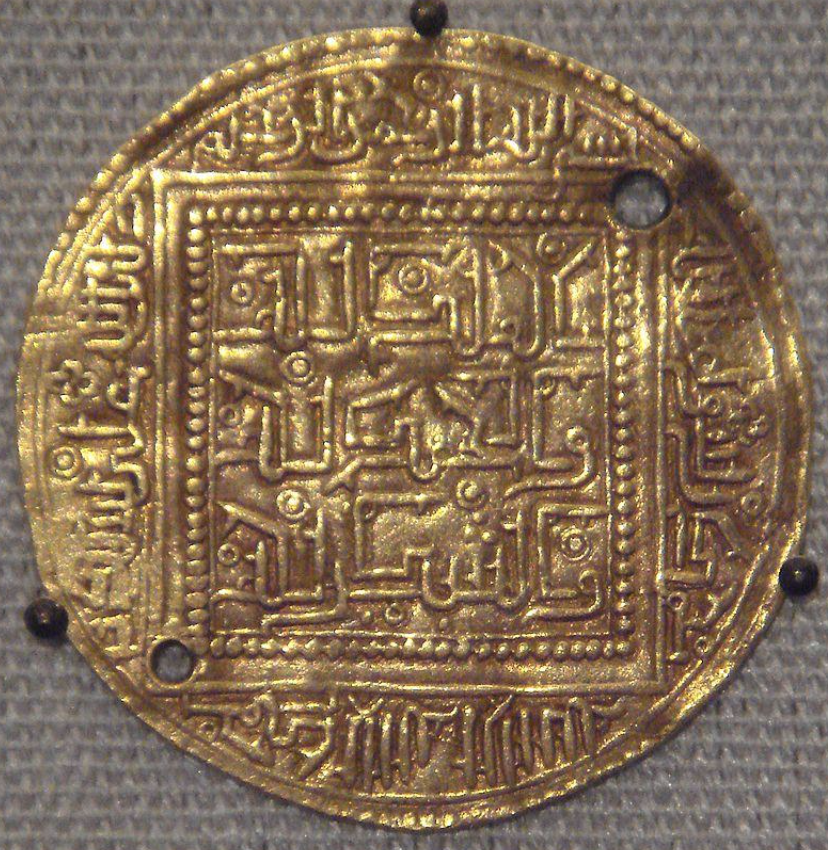
Hafsid coin in Bejaia written in kufic script

Independent Dynasties from the Almohad dynasty

A map representing the dynasties of the Maghreb after the fall of the Almohads