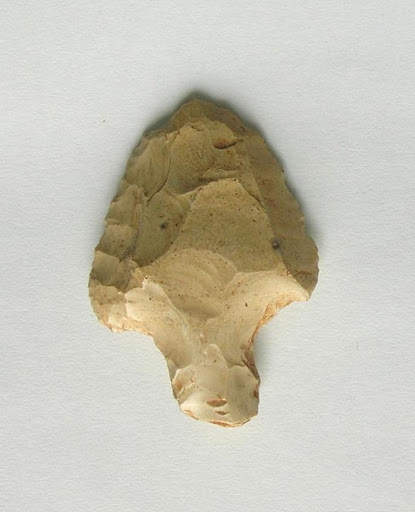
Aterian Civilization
The stone remnants of this industry were discovered for the first time in 1917 AD at the site of Wadi Gabbana near the Bir al-Atir area in Tebessa by researcher Reygasse, however his study was not completed until 1974 AD by J. Morel (J. Morel). This singularity and peculiarity of this site is that it contained both Middle Paleolithic stone tools (scrapers and serrated tools) and Upper Paleolithic artifacts (flat scrapers and numerous other tools). This characteristic has influenced the majority of their sites to the point where the layering of these stone tools has caused them to become entangled and shaded. This civilization was initially named as the Ouedi Djebanna Civilization, after the place where the first stone artifacts of this civilization were unearthed, but it wasn’t until later on that it was known as the “Aterian Civilization”
Experts date the Acheulean civilization's emergence to the end of the Lower Paleolithic and the beginning of the Middle Paleolithic. Pre history scholars believe that the Aterian civilization could have evolved from it. Other scientific studies, however, proved that the Aterian culture descended from the Mousterian civilization that existed before it, based on their similarities. The Aterian civilization, which existed between 45,000 and 20,000 BC, is regarded one of Homosapiens' earliest civilizations.
This geographical area's environment at the time was characterized by lush rain forests, numerous rivers and springs, in addition to a few animal species. According to research, this environment provided the best conditions for the founders of the Aterian civilization, who were quite similar to the Neanderthals.
Considering the significance of the region's ancient stone tool industries, scholars believe the Aterian civilisation is the oldest model of regional technological diversity. They believe that, in addition to its wide spread, it has given rise to several small civilizational branches such as Orania and Al-Kafsia. Its circle began to expand to include first the entire Maghreb countries, then the geographical area extending from the Atlantic Ocean to the Nile River and from the Mediterranean shores to northern Niger and Tchad. The civilizational remains discovered at the Bir al-Atir site ranged from stone tools such as flint to colored paintings on cave walls, as well as a number of decorated tombstones. According to studies, the Aterian man in this region relied on animals, seafood, and plants for sustenance. He also used it as a source of medicine and used the wood from its trees to construct houses and tools for his everyday life. Despite the level of development, the Aterian civilization did not persist long, and the scholars attributed its demise to changes in climatic conditions. Its roaring times were followed by a dry climate that impacted this region in particular and the African desert in general, prompting the people of this civilization, who rely on fishing and agriculture for a living, to relocate to other places in search of better living circumstances, including the desert, coastal nations, and certain tropical African regions. The Aterians may have traveled south to West Africa, possibly reaching Mauritania and Senegal. The Aterian civilization existed until the Neolithic period, when it was succeeded by the Capsian civilization.


The most notable aspect that separates Aterian stone tools from others is their exquisite legs, which demonstrate a tremendous advancement in the stone industry.