Mousterian civilization
The Mousterian Civilization:
The origins of this civilization might have been unclear to certain scientists, however, Flair believes that it has risen in the midst of Asia. He backs his reasoning with the tools that have been discovered, dubbed “pre-mousterian” that Neanderthals carried in their voyages across Europe on the one hand, and through the Asian steppe road to Africa, on the other. The Mousterian civilization's presence in Europe goes back to around 200 thousand years B.C. in some regions, and lasted all the way to 40 thousand years, thus covering the entirety of The Middle Paleolithic age. Some researchers, however, suggest that it was present in North Africa between 80.000 and 50.000 before our present time.
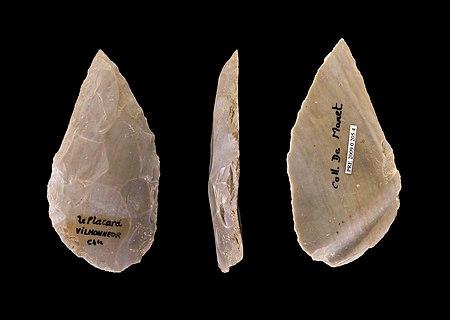
Their tools, mostly made of fine flint fragments, trimmed and pointed, have various uses such as knives, axes, scrapers with an edge, and serrated tools. This industry spread across the entirety of North Africa and the Sahara.
Anthropologically speaking, major changes happened in this period, as the Neanderthal made a first appearance - who specialists consider to be the oldest predecessor to man. This human expanded their circle to include wide regions of the world, North of Europe, East Asia, and surroundings of tropical regions in Africa, where he was the first to set foot into. The Neanderthal achieved notable successes economically and socially, mostly by relying on the heritage of his predecessors and compiling one achievement after the other.
In terms of civilization, academics were perplexed by this age in North Africa since they were unfamiliar with it. All they knew was that its greatest distinguishing feature, particularly its crude tools with pieces, resembled the European Mousterian in overall look. Many academics argued that because it is so similar to the Aterian civilization, and despite the few sites in the desert, including one near "Eniker" and another in "Tin Tamat" in the Hoggar, there was no comparable culture in the Maghreb. There have also been "Tin Hnaqten" and "Turirin" for Tassili, as well as in the northern desert between Ghardaia and Metlili. The Brezina Oasis site in the northern Saharan Atlas contained two distinct civilized levels separated by a layer of coarse sand and gravel, with the lower level revealing coarse sliver industry using the Levallois technique and trimmed stones, and the upper level containing the remains of Aterian “industry”. It is noteworthy, that the distinction between the two civilizations was drawn by the scholar B. Asturge.
Mousterian stone tools