Acheulean Civilization
Acheulean Civilization
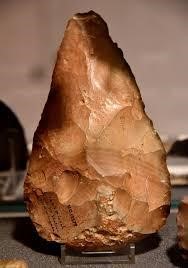
Mankind in this era, used flint stones in the fabrication of their tools. They were flat pieces with pointy edges that came to be as a result of the shattering, and this piece was known as “the bi-facial tool.” Moreover, mankind would use, in the creation of such tools, different techniques. This stone fabrication slowly evolved. Later on, the manual axe appeared, known for its pear-like shape and disorderly edges. Scientists have doubted - at first - such tools to be man-made, however, the increase in finding such tools, and in large numbers in several locations near animal remains, left no room for doubt that they were not of natural source.
This fabrication belongs to the Acheulean civilization (according to its location in St. Acheul in France) where these stone axes have been first discovered. This fabrication/industry is called “the nuclueus industry” because their tools were directly made from the flint nucleus, where people would make adjustments to their sides in order to get a sharp edge However, from a chronological standpoint, they are classified as a Lower Paleolithic civilization.
This Achulean practice first appeared in Eastern Africa and then expanded later on to Northen Africa and the Middle East. Its expansion then reached several European regions.
The remnants of this civilization were located in a number of regions in Algeria, such as In El Karma, located south of Chlef (West), Martin and Dupree Quarry, In Fritsa, In Lahnache (located 9 KM to northwest of the city of El Eulma - Setif). The latter is home to the second oldest stone industry in the world, which dates back to 2.4 million years, after Ethiopia by 2.6 million years.


Achulean stone tools Achulean stone axe

Bi facial Achulean tool from Sabika Site in Algeria